How to Beat Recording Anxiety: A Guide to Pro Guitar Takes
The moment the record light turns red, the guitar feels like it weighs fifty pounds. Your fingers, which were flying through the bridge ten minutes ago, suddenly feel like they are made of lead. Your heart rate spikes, your palms get a little damp, and a basic C major chord feels like a complex mathematical equation.
Welcome to the world of recording anxiety.
Whether you are in your bedroom tracking into a Focusrite or sitting in a world-class Nashville tracking room with a vintage U47 in front of your amp, recording anxiety is the great equalizer. It affects everyone from beginners to seasoned session pros.
At Green Hills Guitar Studio, we believe that recording is a separate skill from playing. You can be a virtuoso in the practice room and a “clunker” in the booth if you haven’t mastered the psychology of the take. This guide is about breaking that cycle and moving from “perfectionism” to “performance.”
What is Recording Anxiety in Music?
Recording anxiety (commonly known as “Red Light Syndrome”) is the physiological and psychological tension a musician experiences when a recording device is active. This phenomenon often causes a dip in technical proficiency, timing, and creative “flow” due to the perceived pressure of capturing a perfect, permanent performance. It is characterized by symptoms like increased heart rate, muscle tension, and “analysis paralysis,” affecting players in both home setups and professional Nashville studios.
To beat recording anxiety, you have to stop trying to be perfect and start trying to be “present.”
5 Quick Tips to Stop Recording Anxiety Today
- Use the Five-Minute Buffer: Let the red light become background noise before you play.
- Advocate for Comfort FX: Ask for reverb or delay in your headphone mix to feel inspired.
- Apply the 10-Take Rule: Give yourself permission to fail for the first thirty minutes.
- Try the One-Ear Trick: Keep one headphone off to stay physically grounded in the room.
- Focus on Target Tones: Simplify your mental map by focusing on intervals rather than patterns.
1. The Home Studio Trap: Separating Engineer from Artist
In the modern era, most intermediate players are their own engineers. This is a blessing for your budget but a curse for your creativity. When you are the one clicking “Record,” setting the gain levels, and checking the buffer size, you are stuck in “Analytic Brain.”
To get a great take, you need to be in “Creative Brain.” Recording anxiety often stems from this mental friction. You are trying to watch the meters while you should be watching your phrasing.
The “Five-Minute Buffer” Technique
One of the best ways to trick your brain at home is to hit record and then… do not play. Hit the button, walk away, grab a glass of water, or tune your guitar for the fifth time. By the time you sit down to actually play, the “event” of starting the recording has passed. The red light is already part of the room’s furniture. You aren’t “starting” a take; you are just joining a session that is already in progress.
Stop the “Insta-Loop” Critique
The biggest mistake home recorders make is stopping the take the second they hear a fret buzz or a muffled note. This trains your brain to expect failure and feeds your recording anxiety. Commit to finishing the pass, even if you know it is a throwaway. You might find that the “mistake” actually had a vibe that works, or that your best playing happened right after the flub because you finally relaxed.
2. Navigating the Mid-Sized Professional Studio
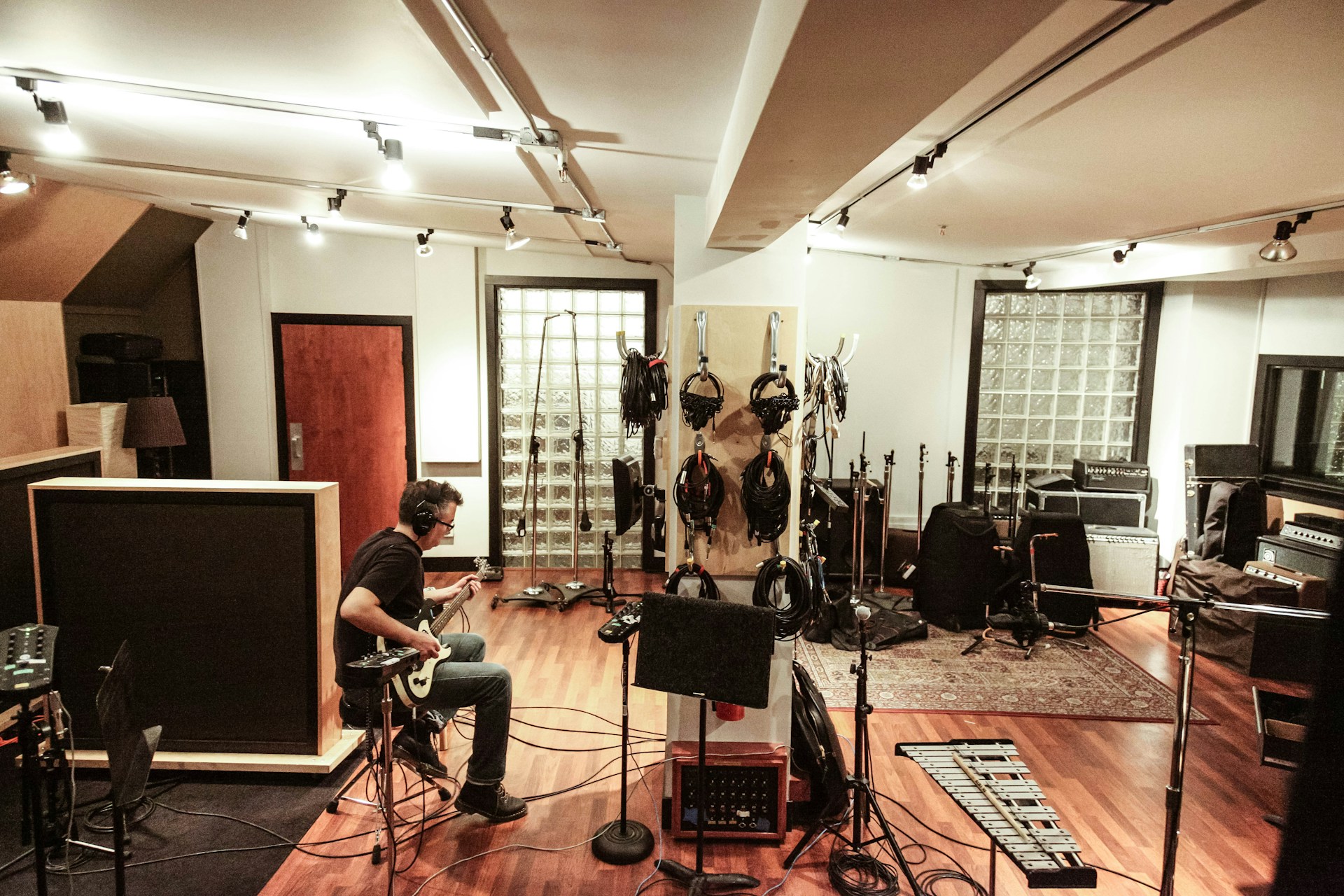
Stepping into a professional studio introduces new variables that can skyrocket your recording anxiety: the clock, the cost, and the engineer.
The “Cost-Per-Note” Fallacy
It is easy to sit in a booth and think about the hourly rate. This mindset is the fastest way to stiffen your playing. Instead, view the studio fee as a “Creative Exploration Tax.” You aren’t paying for a finished product; you are paying for the environment that allows the product to happen. The most expensive thing you can do in a studio is play “safe.” Safe playing is boring, and boring tracks get buried in the mix.
Advocacy in the Headphones
Your “cans” (headphones) are your only window into the music. If the click track is too loud, or if your guitar sounds thin and “pointy,” you will play with hesitation.
Do not be afraid to ask the engineer for “more me,” “less click,” or a “comfort verb.” A little bit of plate reverb in your ears can make your dry guitar signal feel like it is in a real space, which helps you lean into the notes. If it sounds like a record in your ears, you will play like a pro.
3. The Physicality of the Take: Ergonomics Matter
Sometimes what feels like recording anxiety is just your body telling you that your setup is wrong. In the studio, ergonomics are everything.
- The “Same Chair” Rule: If you practiced the song sitting on a drum throne, do not try to record it standing up with a heavy strap. Your physical relationship with the fretboard changes based on your posture.
- The “Angle of Entry”: Make sure your music stand or lyric sheet is at a height where you do not have to crane your neck. If you are physically uncomfortable, your brain will translate that tension into your picking hand.
- Temperature Control: Nashville studios can be notoriously cold to keep the gear happy. If your hands are cold, you are done. Ask for a space heater or bring a hoodie. Warm hands are fast hands.
4. The 10-Take Rule: Permission to Fail
Here is a secret from the pro session world: the first three takes are almost always for the engineer. They are checking levels, adjusting EQ, and making sure the phase is right.
Adopt a “10-Take Rule” for yourself. Tell yourself that the first ten passes are strictly for “cleaning the pipes.” They are throwaways. When you give yourself permission to fail for the first half-hour, you remove the “all or nothing” pressure of the first take. Paradoxically, this usually leads to the “keeper” take happening around Take 4 or 5.
5. The “One-Ear” Trick and Other Pro Secrets
If you feel disconnected from the music while wearing headphones, try taking one ear off. This allows you to hear the natural “thump” and resonance of your guitar in the room while still hearing the backing track in the other ear. This “hybrid” listening environment is a favorite for Nashville session players because it keeps them grounded in the physical act of playing.
6. Performance Psychology: The Science of the “Groove”
Understanding why your brain glitches can help you override the system. When you are nervous, your sympathetic nervous system kicks in. This “fight or flight” response is great for running from a lion, but it is terrible for fine motor skills like playing a 16th-note folk fingerpicking pattern.
To combat this, you need to “chunk” your information. This is where our “Neighborhood Method” comes in. Instead of thinking about every individual note, think about the “shape” of the chord or the “anchor” of the root note. When you simplify the mental map of the fretboard, you leave more room for your ears to actually listen to the music.
7. The “Dry Signal” Confidence Gap
Most studios record a “dry” signal to give the mixing engineer more options later. However, playing a bone-dry electric guitar can feel like standing naked in a supermarket. It is unforgiving.
Always advocate for a “vibe” in your monitors. If you need a specific delay time to feel the rhythm of the part, ask for it. A professional engineer knows that a great performance on a slightly “wet” monitor mix is better than a stiff performance on a dry one.
8. Post-Session Recovery: The 24-Hour Rule
Your ears are different after a three-hour session than they are the next morning. Never judge your takes the night you record them. The adrenaline and fatigue of a session skew your perspective.
Go home, get some sleep, and listen to the rough mixes the next day with a cup of coffee. You will almost always find that the parts you thought were disasters have a charm and character that you could not see in the heat of the moment.
Conclusion: The Goal is Not Perfection
The history of great guitar playing is a history of “beautiful mistakes.” The slightly late 16th note, the “woodiness” of a string that did not quite ring true, the “dry” grit of a raw performance… these are the things that make listeners connect with your music.
Recording anxiety is just your ego trying to protect you from being “human.” But in the world of indie folk, Americana, and rock, being “human” is exactly what the listener wants.
Next time you see that red light, do not think of it as a judge. Think of it as an invitation.
Reach Your Full Potential at Green Hills Guitar Studio
Recording anxiety shouldn’t keep your music trapped in your practice room. Whether you are prepping for your first Nashville session or just want to master the Neighborhood Method so you can play with total fretboard freedom, let’s get to work.
We offer premier music lessons in Nashville and online to help you move past the “bedroom plateau” and start playing with professional confidence. At Green Hills Guitar Studio, we don’t just teach you how to play guitar; we teach you how to be a musician.
![How to Find the Best Guitar Instructor [Parents & Adult Learners] | Green Hills Guitar Studio](https://greenhillsguitarstudio.com/wp-content/uploads/2026/02/How-to-Find-the-Best-Guitar-Instructor-Parents-Adult-Learners-768x512.jpg)