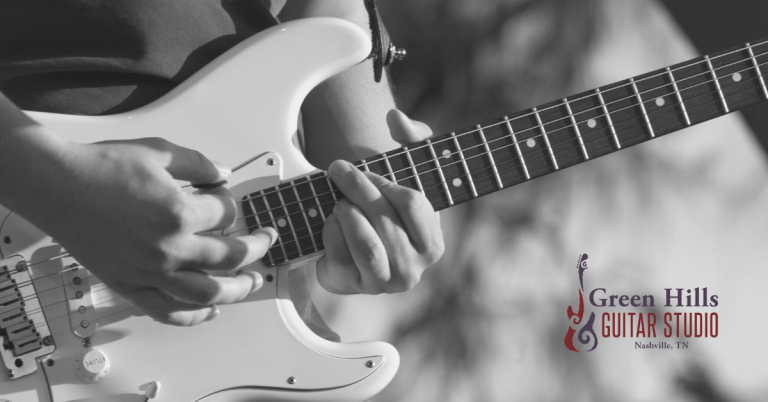

How to Visualize the Guitar Fretboard: Building an Internal Map
You’re halfway through a solo or working through a new chord progression when you decide to venture past the fifth fret. Suddenly, the neck feels like a room with the lights turned off. You know the notes are there, but you’re reaching for them in the dark and hoping your muscle memory doesn’t fail you.
That moment of hesitation usually isn’t about talent. It usually means your internal map of the fretboard is still developing.
Real freedom on the instrument comes from having a clear mental picture of where notes, chords, and intervals live. At Green Hills Guitar Studio, we like to think about that map in terms of fretboard neighborhoods.
A neighborhood is simply a small region of the fretboard, usually four or five frets wide, where you can find the important notes of a key without moving your hand very far. Within that space, you should be able to locate:
- chord tones
- nearby scale tones
- useful chord shapes and inversions
Once those relationships become familiar, the guitar neck stops feeling like a maze and starts feeling like a series of connected musical spaces.
What Is Fretboard Visualization?
Fretboard visualization is the ability to quickly recognize where notes, chords, and intervals exist across the guitar neck without relying entirely on memorized diagrams.
Instead of searching for notes, you start to understand how chord tones, scale tones, and intervals relate to each other within each area of the neck.
This skill allows guitarists to:
- improvise more confidently
- connect chords and melodies
- navigate the neck without hesitation
- understand how music theory applies to the instrument
Practicing within small fretboard regions is one of the fastest ways to build this awareness.
Seeing the Guitar as Architecture
Most guitarists begin by memorizing shapes. Scale patterns, chord diagrams, and familiar fingerings are essential tools for learning the instrument.
Those shapes are useful, and experienced players still rely on them all the time. What changes over time is how you see inside those shapes.
Instead of only remembering finger placements, you begin to recognize the interval relationships within them:
- where the root sits
- where the third appears
- how the fifth relates to the root
- how scale tones surround chord tones
Once you start recognizing those relationships, every area of the fretboard becomes easier to navigate.
Think of it like learning a city. At first you follow directions everywhere you go. Eventually you start recognizing streets, landmarks, and shortcuts. The guitar works the same way.
What a Fretboard Neighborhood Looks Like
Let’s look at a simple example in the key of C major around the 3rd through 5th fret area. Within that small region, you can already find several notes that define the key.
Some of the important notes in this area include:
- C
- E
- G
- A
- D
Because these notes appear on several strings within a short distance, they allow you to outline multiple chords without shifting positions.
Inside this neighborhood you can build or outline:
- C major
- A minor
- D minor
- G major
- partial versions of F major
You also have access to the C major scale tones needed to create melodies between those chords.
The goal isn’t to stay in one place forever. The goal is to understand what’s available in each area so that movement across the neck becomes intentional rather than random.
Horizontal and Vertical Thinking
Many guitarists first learn scales as patterns that move horizontally up and down the neck. That’s great for developing technique and speed.
But when music moves quickly through chord changes, it often helps to think vertically within a smaller fretboard region.
Instead of chasing notes across the neck, you explore the notes that surround your current hand position.
Within one neighborhood you can usually find:
- chord tones
- scale tones
- melodic ideas
- chord fragments
The more comfortable you become within these regions, the less frantic your playing feels when the harmony changes.
The Guitar’s Built In Geometry
One of the most helpful features of the guitar is that most of the strings are tuned in perfect fourths. Because of this, interval shapes repeat as you move across the strings.
For example, if you find a root and its fifth on the low E and A strings, you’ll see the same relationship again on the A and D strings and again on the D and G strings.
This repeating structure is one reason guitarists rely on shapes.
There is one small adjustment.
The G and B strings are tuned a major third apart instead of a fourth. Because of that difference, patterns that cross from the G string to the B string shift slightly compared to the rest of the neck.
In practice, shapes that cross that boundary usually move one fret higher than expected.
Once you’re aware of that adjustment, the rest of the fretboard becomes much easier to predict.
How This Connects to Other Guitar Learning Systems
If you’ve studied approaches like CAGED, three note per string scales, or position playing, you’ve already encountered many of these ideas.
Each method highlights a different aspect of the instrument.
- CAGED helps guitarists understand how chord shapes connect across the neck.
- Three note per string scale systems are useful for developing speed and recognizing scale patterns.
- Position based practice encourages staying within a defined fretboard region.
The neighborhood idea simply emphasizes the relationships inside a position, especially the connection between chord tones and nearby scale tones.
These approaches are not competing systems. They’re just different ways of describing the same instrument.
How to Start Visualizing the Guitar Fretboard
If fretboard visualization feels overwhelming, start with these simple steps.
- Learn the root notes on the low E and A strings.
- Locate the major and minor third near each root.
- Identify the fifth relative to the root.
- Practice finding these notes within a four fret region.
- Connect those chord tones with nearby scale tones.
Practicing these steps regularly will gradually make the fretboard feel smaller and easier to understand.
Three Exercises to Strengthen Your Fretboard Visualization
These drills focus on understanding relationships rather than memorizing more patterns.
Static Progression Challenge
Choose a simple three chord song. Pick a four fret area of the neck and keep your hand inside that region. Play the entire progression using:
- chord fragments
- inversions
- partial shapes
This exercise helps you discover new voicings within one neighborhood.
The Interval Hunt
Choose a root note on the A string. Without playing a full scale, locate nearby:
- the third
- the fifth
- the seventh
Try to find these notes within two frets of the root. Move the root to a different location and repeat the exercise. This helps you see how chord tones cluster around each other.
Voice Leading Exercise
Try this progression:
- Am
- Dm
- G
- C
Instead of jumping to the root position of each chord, try to move between chords by changing only one or two notes at a time. This creates smoother transitions and helps you hear the connection between chords.
A Fretboard Visualization Checklist
If you’re trying to see the neck more clearly, focus on these fundamentals.
Know your root notes on the low E and A strings
Most chord shapes grow from these anchors.
Recognize major and minor thirds
These intervals determine whether a chord sounds major or minor.
Find the fifth quickly
The root and fifth relationship appears everywhere on the guitar.
Practice within small fretboard areas
Exploring four or five fret regions makes the neck feel smaller and easier to navigate.
Connect chord tones with scale tones
Melodies often emphasize notes that belong to the chord.
The more often you notice these relationships, the faster the fretboard begins to make sense.
Core Interval Landmarks on the Guitar
| Interval | What It Does | Why It Matters |
|---|---|---|
| Root | The tonal center of a chord or scale | Helps you orient yourself on the neck |
| Major Third | Defines a chord as major | Important for outlining harmony |
| Minor Third | Defines a chord as minor | Crucial for the emotional quality of music |
| Perfect Fifth | Stabilizes the chord | One of the most recognizable shapes on guitar |
| Seventh | Adds color and tension | Often targeted in blues, jazz, and modern styles |
Common Fretboard Visualization Mistakes
Many guitarists struggle with the fretboard for a few predictable reasons.
- Trying to memorize too many patterns at once: Adding more scale diagrams often creates confusion instead of clarity.
- Ignoring chord tones: If practice focuses only on scales, melodies can sound disconnected from the harmony.
- Moving constantly across the neck: Shifting positions too frequently prevents you from learning what exists in one area.
- Never identifying intervals: Knowing whether a note is a root, third, fifth, or seventh helps the fretboard make musical sense.
Focusing on these fundamentals makes the instrument far easier to navigate.
Turning the Lights On
When the fretboard feels unfamiliar, it’s easy to rely entirely on muscle memory. As your understanding of intervals and chord tones improves, the guitar begins to feel much more predictable.
The goal isn’t to abandon shapes or memorized patterns. Those tools remain extremely useful.
The goal is to recognize the musical relationships inside them.
Once that happens, the guitar neck stops feeling like a blur of wood and wire. It becomes a connected map where chords, scales, and melodies all live together.
Take Guitar Lessons at Green Hills Guitar Studio
If you’d like help developing a clearer understanding of the fretboard, Green Hills Guitar Studio offers private guitar lessons in Nashville for players of all levels.
Lessons focus on practical musicianship including:
- fretboard visualization
- improvisation and soloing
- chord vocabulary and voice leading
- understanding music theory on the guitar
Whether you’re just getting started or you’re trying to break through a playing plateau, working with a teacher can make a huge difference. Schedule a guitar lesson or check out our course below to start building your internal map of the guitar neck.

![How to Find the Best Guitar Instructor [Parents & Adult Learners] | Green Hills Guitar Studio](https://greenhillsguitarstudio.com/wp-content/uploads/2026/02/How-to-Find-the-Best-Guitar-Instructor-Parents-Adult-Learners-768x512.jpg)