
How to Use Guitar Triads Across the Fretboard
Most guitarists learn chords as fixed shapes: G lives here, C lives there, barre chords live somewhere farther up the neck.
Triads are one of the best ways to get past that.
A triad is simply a three-note chord, but learning those three notes in different positions gives you a much clearer picture of how harmony is laid out across the guitar. Instead of knowing one place to play a chord, you start seeing several.
In this guide, we’ll look at major, minor, diminished, and augmented triads, how inversions work, and how to use these shapes on different string sets. More importantly, we’ll look at how to practice them so they become useful in actual music.
What Are Triads?
A triad is a three-note chord built from a root, third, and fifth.
Those three notes tell you most of what you need to know about the basic character of a chord. Change the third and you can move between major and minor. Alter the fifth and you can create diminished or augmented sounds.
For guitarists, the real value of triads is that they let you see and play the same chord in several places on the neck.
Why Guitarists Should Learn Triads
Triads help with a few things at once:
- Fretboard awareness: You start recognizing where the same chord lives in different positions.
- Cleaner chord voicings: Three notes are often all you need, especially when playing with a bass player, keyboard player, or second guitarist.
- Smoother movement: Inversions make it easier to move between chords without jumping around the neck.
- Better lead playing: Triads show you the chord tones underneath scales and melodies.
- Arranging: Different inversions give you different textures without changing the harmony.
How to Play Triads on the Guitar
Triads can be played on several different string sets, and the shapes change depending on which note is on the bottom.
You’ll want to learn four basic chord qualities:
Chord quality:
- Major: root, major third, perfect fifth
- Minor: root, minor third, perfect fifth
- Diminished: root, minor third, diminished fifth
- Augmented: root, major third, augmented fifth
You’ll also encounter three positions for each triad.
Triad inversions:
- Root position: the root is the lowest note
- First inversion: the third is the lowest note
- Second inversion: the fifth is the lowest note
The notes don’t change. Only their order does.
That may sound like a small distinction, but on guitar it gives you several different ways to play the same chord without leaving the area of the neck you’re already in.
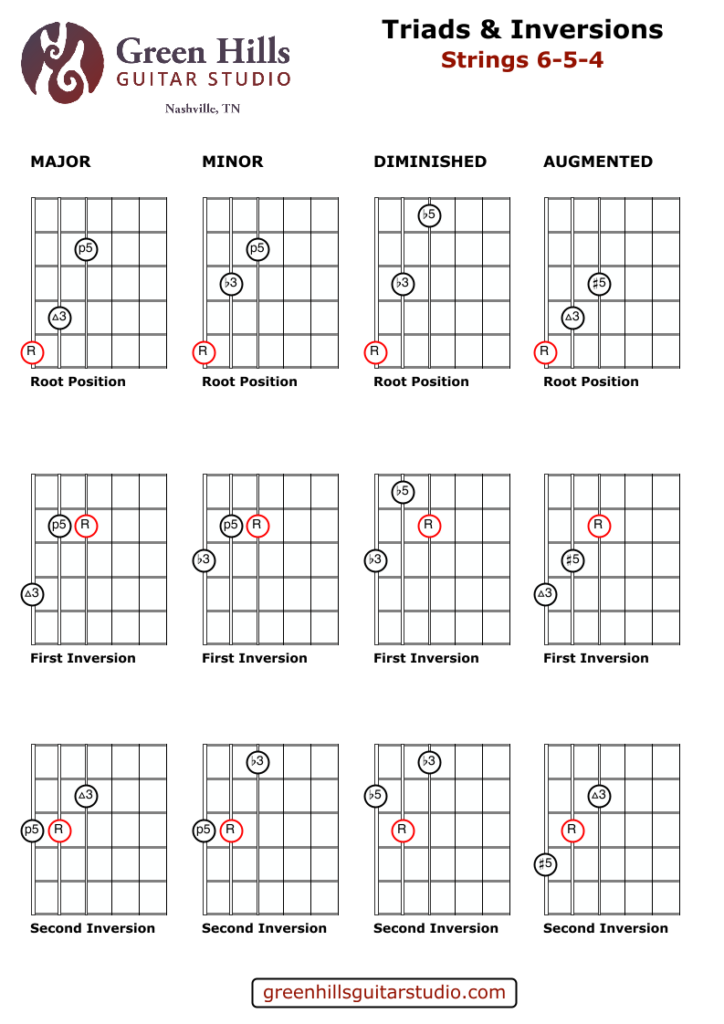
Triads on Strings 6–5–4
These shapes sit in the lower register and can sound fuller and heavier. They’re useful when you want the weight of the lower strings without playing a full six-string chord.
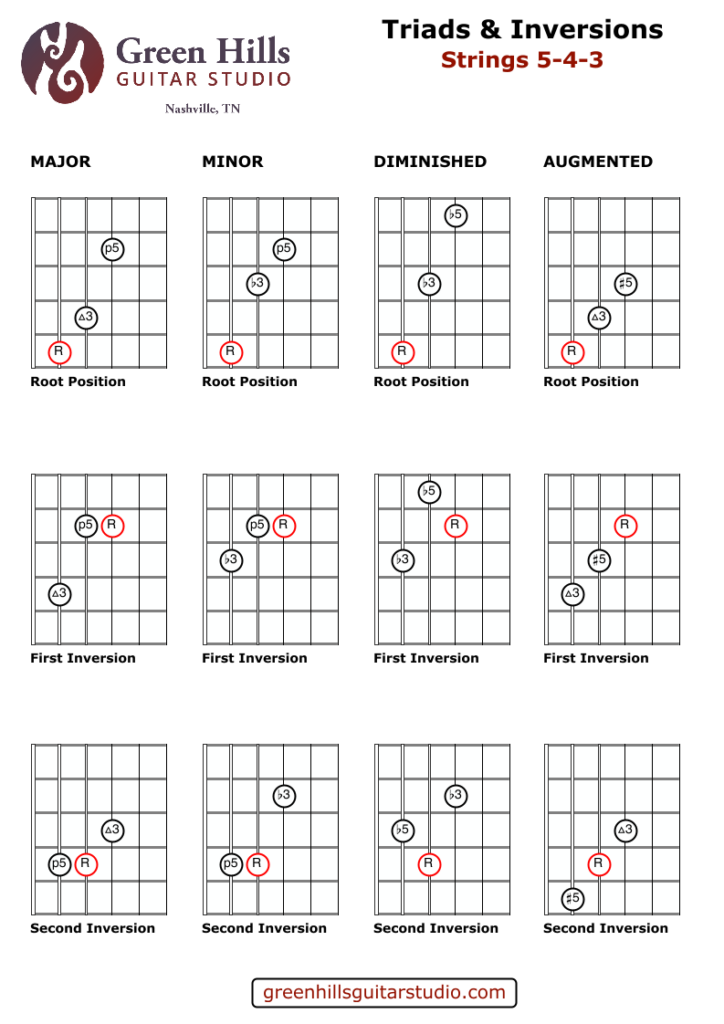
Triads on Strings 5–4–3
This string set puts the chord in a very useful middle register. These shapes work well for rhythm parts, accompaniment, and situations where you want to stay out of the bass range.
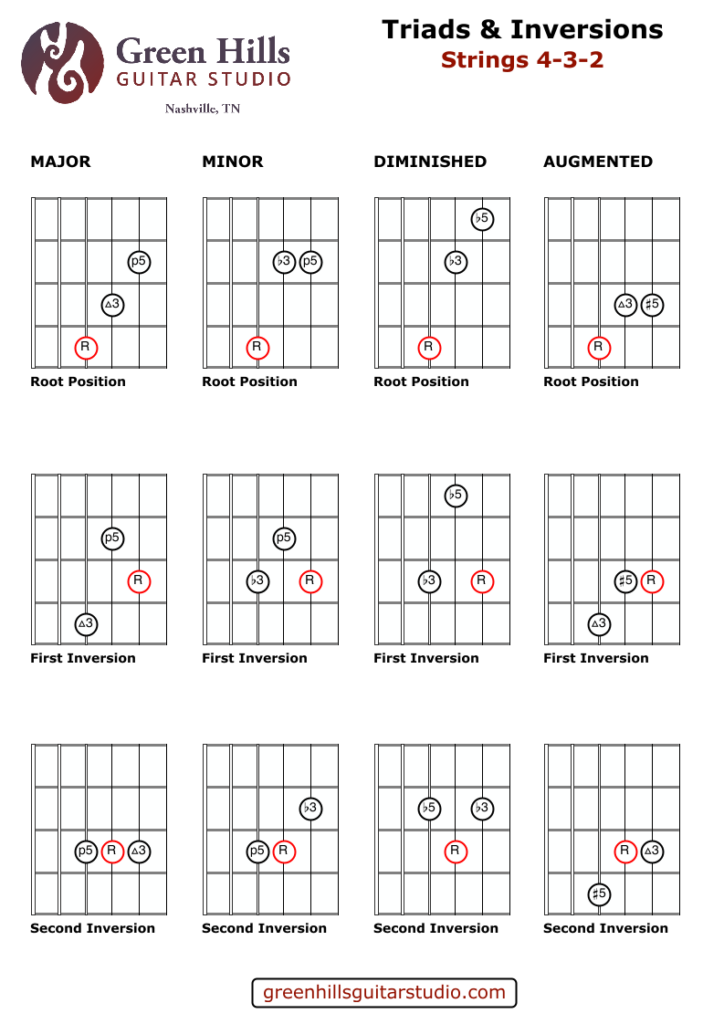
Triads on Strings 4–3–2
Moving higher gives you a clearer, more focused sound. These shapes are especially useful for rhythm guitar, chord fills, and parts that need to sit above another guitar or keyboard.
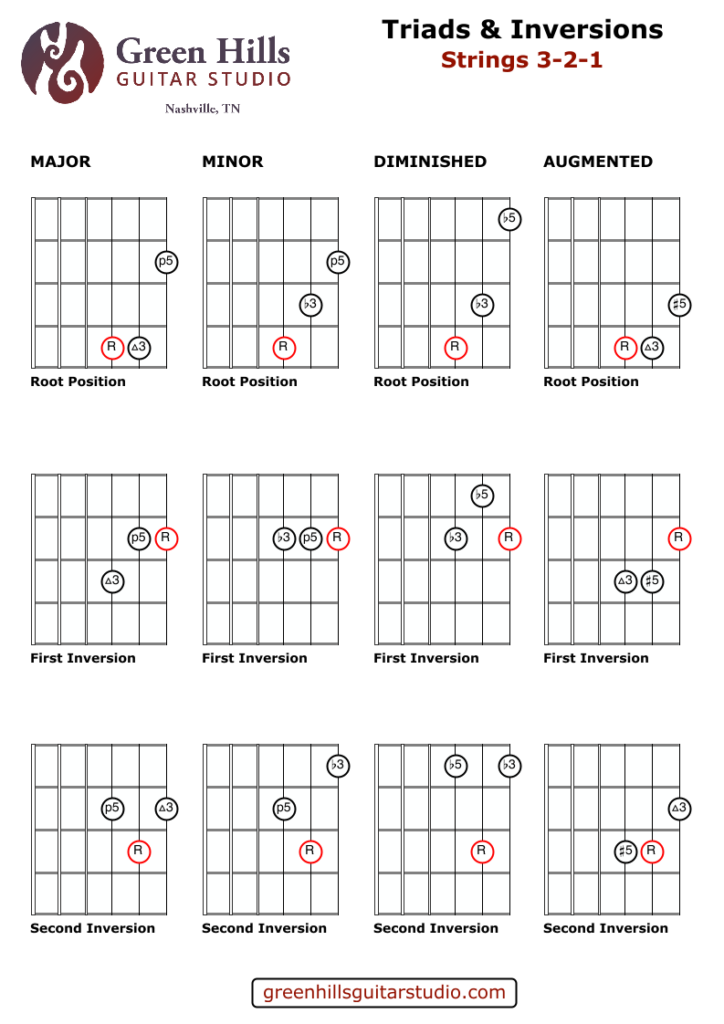
Triads on Strings 3–2–1
These are the highest triad shapes covered here. They’re useful for bright chord voicings, melodic fills, harmonized lines, and connecting rhythm and lead guitar.
Connecting Triads Across the Neck
This is where triads start becoming more than a collection of shapes.
The goal isn’t to memorize every diagram and hope you remember it later. The goal is to recognize that the same chord keeps appearing in different places.
Here are a few ways to practice that.
Exercise 1: Find One Chord in Several Places
Pick one chord, such as G major.
Find it in root position, first inversion, and second inversion on one string set. Then repeat the process on the other string sets.
Don’t rush. Pay attention to where the root, third, and fifth move.
Exercise 2: Play a Chord Progression Using Only Triads
Take a progression such as:
C – G – Am – F
Instead of using your usual open or barre chords, find nearby triad shapes for each chord. Try to move as little as possible between them.
This is a good way to start hearing inversions instead of just seeing them as diagrams.
Exercise 3: Put the Shapes Into Rhythm
Once the shapes are comfortable, stop treating them like an exercise.
Play eighth-note rhythms. Add rests. Use muting. Try syncopation. Move one inversion up or down while the rest of the progression stays the same.
The point is to make them sound like music.
How to Use Triads in Real Music
Once you know a few shapes, you can start using them almost immediately.
1. Rhythm Guitar
Triads are often a better choice than full barre chords when another instrument is already covering the lower register.
They give you enough harmony to define the chord without taking up more space than you need.
2. Lead Guitar
Triads also give you target notes.
If you know where the chord tones are while a progression is moving underneath you, your solos can follow the harmony instead of simply running through a scale shape.
3. Songwriting and Arranging
The same progression can feel very different depending on which inversions you use.
Try moving a familiar song into different triad positions and listen to how the top note changes. That single note can completely alter the character of a part.
A Simple Way to Practice Triads
You don’t need to learn every shape at once. Start with one chord quality, usually major or minor, and one string set.
Then:
- Learn root position, first inversion, and second inversion.
- Move those shapes through a few different keys.
- Apply them to a simple progression.
- Use them in a song you already know.
- Add another string set once the first one feels familiar.
You’ll remember the shapes much better when they’re connected to music instead of practiced as isolated diagrams.
Triads and the CAGED System
Triads fit naturally into the CAGED system because they’re smaller pieces of the larger chord shapes.
Once you can see the full C, A, G, E, and D forms across the neck, triads help you break those shapes into more practical voicings.
That makes it easier to move between rhythm parts, lead ideas, chord embellishments, and scale shapes without feeling like each one belongs to a different part of the fretboard.
Start With One Chord
You don’t need to memorize the entire neck before triads become useful.
Pick one chord you already know well and find three different places to play it. Then try using those shapes in a progression or song.
That’s usually where the fretboard starts to make a little more sense: not because you memorized more information, but because you started seeing how the same notes and chords connect.
If you want help applying triads, inversions, CAGED shapes, and fretboard concepts to your own playing, you can also work with one of our instructors through private guitar lessons.
![How to Find the Best Guitar Instructor [Parents & Adult Learners] | Green Hills Guitar Studio](https://greenhillsguitarstudio.com/wp-content/uploads/2026/02/How-to-Find-the-Best-Guitar-Instructor-Parents-Adult-Learners-768x512.jpg)