

Why You Can Play Hard Songs But Still Can’t Improvise
You can play difficult songs. You can memorize solos. You can learn riffs, run scale patterns, and maybe even play fast when the part is written out in front of you.
Then someone turns on a backing track and says, “Take a solo.”
Suddenly, everything disappears.
You know the notes. You know the shapes. You may even know the theory. But when it is time to create something in real time, your hands either run the same scale pattern up and down, fall into tired licks, or freeze completely.
That gap is frustrating, but it is also very common. It does not mean you are untalented. It does not mean you waited too long to learn improvisation. It usually means you have practiced guitar in a way that rewards memorization more than musical decision-making.
A difficult solo gives you the answers. Improvisation asks you to make choices.
In this lesson, we will use the A minor pentatonic scale as a simple framework for understanding why many guitarists can play hard songs but still struggle to improvise. The goal is not to learn more patterns for the sake of learning more patterns. The goal is to start turning familiar patterns into phrases, melodies, and musical ideas.
Playing songs and improvising are related, but they are not the same skill
When you learn a hard song, you are usually working on memory, coordination, tone, timing, and picking accuracy. You listen to a part, learn where the fingers go, repeat it slowly, and gradually bring it up to tempo. That is valuable work. Every guitarist needs it.
Improvisation uses many of those same ingredients, but it adds another layer. You have to decide what to play while the music is happening.
That means you are not only asking:
- Can I play this note cleanly?
- Can I get to the next position?
- Can I keep time?
You are also asking:
- What does this note sound like over the chord?
- Does this phrase need to continue or stop?
- Should I repeat the idea or answer it?
- Should I leave space?
- Where does the line want to resolve?
That is why a guitarist can play a technical solo note-for-note but still feel lost over a simple blues, rock, country, or folk progression. One skill is built around executing a known part. The other is built around hearing, choosing, reacting, and shaping musical ideas in the moment.
Improvisation is not random. It is real-time composition using the vocabulary you have practiced.
The A minor pentatonic scale is useful, but the box is not the music
The A minor pentatonic scale contains five notes:
A, C, D, E, and G
Those notes can also be understood as:
Root, b3, 4, 5, and b7
That simple five-note sound is everywhere. Blues, rock, country, soul, funk, folk, pop, and countless guitar solos all lean on the minor pentatonic scale. It is one of the most useful sounds a guitarist can learn.
The problem is not the scale.
The problem is what many players do with it.
If you only see the pentatonic scale as a fingering pattern, you will probably sound like you are practicing a fingering pattern. You may move up and down the shape correctly, but the line may not say much. It may not breathe. It may not respond to the band. It may not land anywhere.
Look at this first A minor pentatonic diagram. Notice that the A notes are highlighted in red. Those are not just dots on the neck. They are home base.
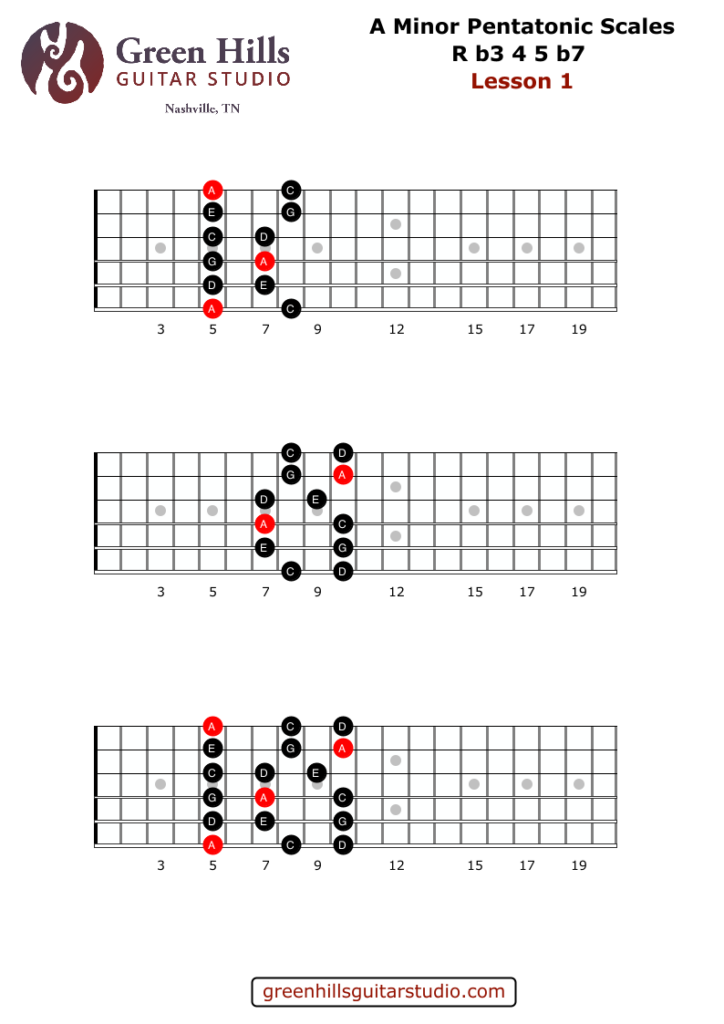
When students first learn this kind of diagram, they often focus on getting through the pattern. That is normal. But the musical value begins when you ask better questions:
- Where are the A notes?
- Which notes feel stable?
- Which notes create motion?
- Which notes sound more vocal when bent, slid, or repeated?
- Can I make one small phrase instead of running the whole shape?
The red A notes matter because they help you hear resolution. If you do not know where “home” is, it is hard to make a line feel finished.
Reason 1: You know the shape, but not the sound of each note
A scale pattern tells your fingers where they can go. It does not automatically tell your ear what each note means.
In A minor pentatonic, each note has a different job:
- A feels like home. It is the root.
- C gives the scale its minor color. It is the b3.
- D creates motion. It is the 4.
- E feels strong and stable. It is the 5.
- G adds bluesy pull and tension. It is the b7.
If you treat all five notes the same, your solo may sound flat even if you are playing the “right” notes. Improvisation gets more musical when you start noticing how each note feels against the chord underneath it.
It’s about developing your ear.
Try this exercise with the first diagram:
- Play only A notes.
- Then play only A and C.
- Then add E.
- Make short phrases using only A, C, and E.
- Add D and G only when you want motion or tension.
This is one of the fastest ways to stop sounding like you are running a scale. You are training your ear to hear the weight of each note.
Many players try to improve their improvisation by learning more scales. Sometimes that helps, but often the better move is to learn fewer notes more deeply. You do not need ten new patterns before you can make music. You need to hear more inside the pattern you already know.
Reason 2: You are practicing patterns instead of phrases
A scale pattern is not a solo. It is raw material.
Think about language. Knowing the alphabet does not mean you can write a sentence. Knowing words does not mean you can tell a story. Music works the same way. Notes become meaningful when they are organized into phrases.
A phrase has shape. It has rhythm. It has a beginning and an ending. It might repeat an idea. It might leave space. It might answer something that came before it.
If your improvisation sounds stiff, listen for these common problems:
- Every note has the same length.
- Every phrase starts on beat one.
- Every line runs continuously with no breathing room.
- You always start on the lowest note in the box.
- You always end on whatever note your fingers happen to land on.
- You use the scale shape as a route instead of using it as a vocabulary.
The second A minor pentatonic diagram gives you more of the neck, but the goal is still not to play every note.

Try this instead:
Choose three notes from the diagram. For example, A, C, and D. Set a slow backing track in A minor. Create a two-measure phrase using only those three notes.
Then repeat it.
Then change the rhythm but keep the same notes.
Then keep the rhythm but change the ending note.
That is improvisation practice. You are not just asking your fingers to move. You are shaping an idea.
Reason 3: You are not leaving space
Many guitarists think improvisation means playing more. Usually, better improvisation starts when you play less.
Space gives the listener time to understand what you just played. It also gives you time to hear what the band is doing. Without space, even good notes can become exhausting.
A simple test:
Record yourself improvising for one minute over an A minor backing track. Then listen back and ask:
- Did I pause?
- Did I repeat any idea?
- Could I sing any phrase I played?
- Did I sound like I was responding to the music, or just filling time?
- Did the solo have any clear beginning, middle, or end?
If the answer is no, do not add more theory yet. Work on space.
Here is a simple practice rule:
Play one short phrase, then rest for the same amount of time.
If you play for two beats, rest for two beats. If you play for one measure, rest for one measure. At first, this may feel uncomfortable. That is good. It forces you to stop noodling and start listening.
The best improvisers are not thinking only about notes. They are thinking about timing, tone, silence, repetition, and response.
Reason 4: You are not connecting positions musically
A lot of players learn the first pentatonic box, then the second, then the third, and so on. That is fine as a learning sequence. But if the five positions stay separate in your mind, you may feel trapped.
You might know all five boxes and still only improvise in one of them.
The goal is not to memorize five isolated shapes. The goal is to see one connected fretboard.
This next diagram starts showing how the A minor pentatonic scale overlaps across positions.
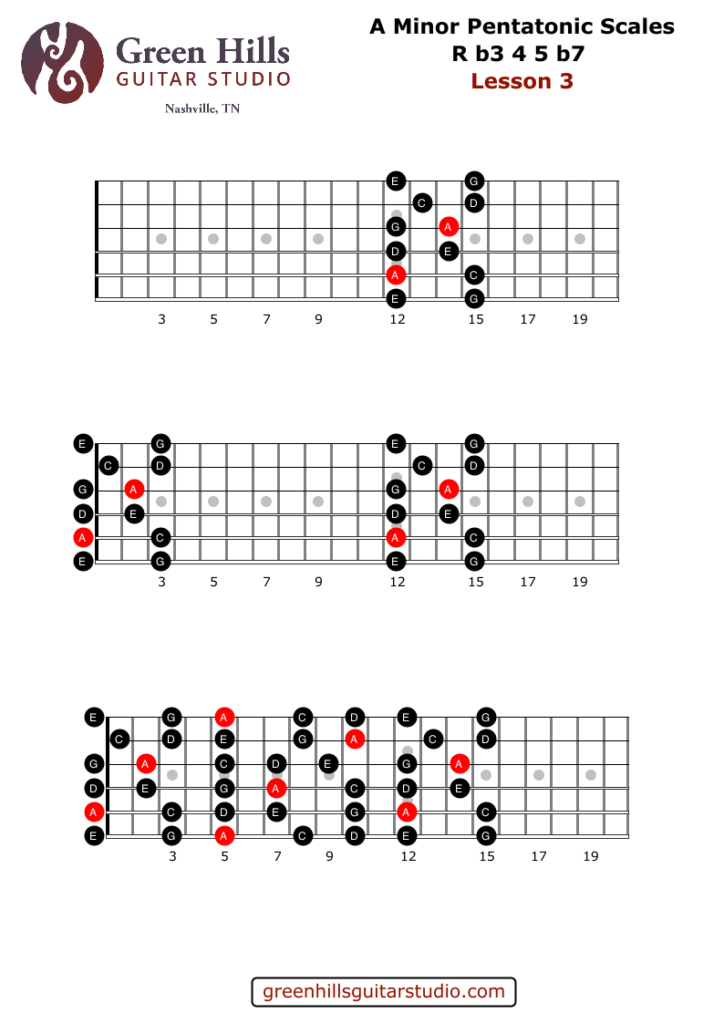
When you practice connecting positions, do not simply run from the lowest note to the highest note. That often trains your hands more than your ear.
Instead, connect positions with a musical reason.
For example:
- Start a phrase in one position and answer it in the next.
- Slide from one A note to another A note.
- Repeat the same rhythmic idea in a new area of the neck.
- Move to a higher position only when the solo needs more intensity.
- Move to a lower position when the phrase needs to settle down.
Position shifts should feel like musical choices, not escape routes.
A good exercise is to take one small phrase from the first position and move it to another part of the neck. The notes do not have to be identical every time. The point is to carry the idea, not just the fingering.
That is how the fretboard starts to feel connected.
Reason 5: You are not aiming for chord tones
Pentatonic scales are powerful because they are simple, flexible, and familiar to the ear. But even within a pentatonic scale, you still need to care about the chords.
If you are playing over an A minor groove, the A minor pentatonic scale will usually sound comfortable. But if the progression moves, your note choices can feel stronger or weaker depending on the chord underneath.
For example, over an A minor chord, the notes A, C, and E are especially strong because they outline the chord.
Over a D minor chord, D and A may feel more grounded.
Over an E or E7 chord, E becomes a strong landing point, and G may create a bluesy tension depending on the style.
This does not mean you need to calculate every note while you play. It means you should start hearing which notes feel settled, tense, bright, dark, finished, or unresolved.
Improvisation becomes much stronger when you stop asking, “What scale can I use?” and start asking, “What note do I want to land on right now?”
This is the bridge between scale practice and real soloing.
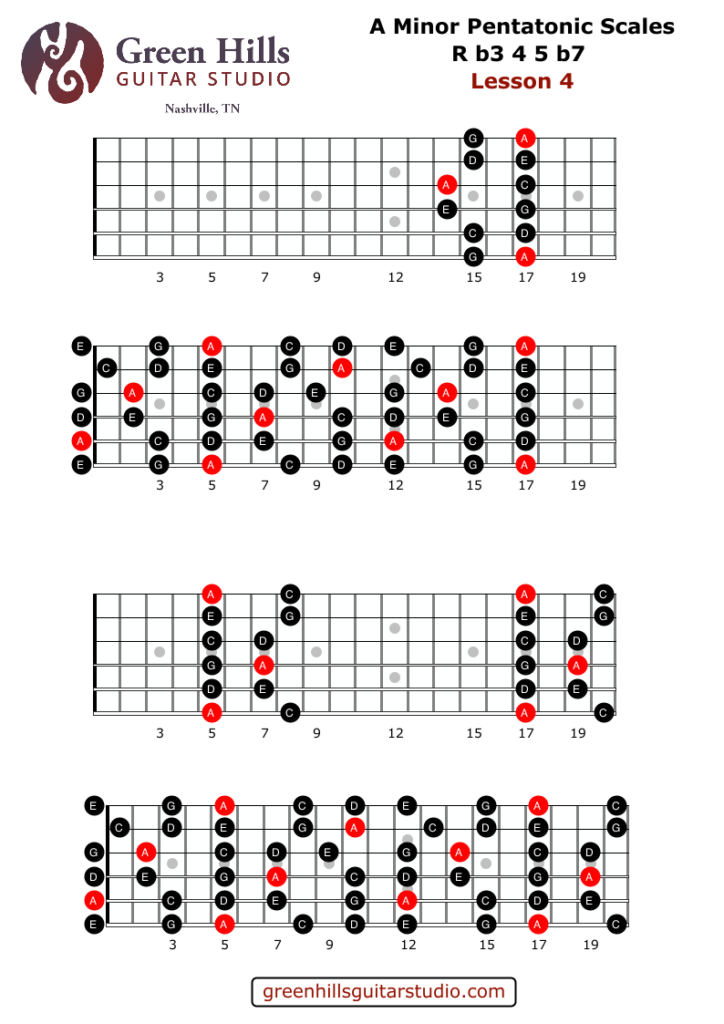
Try this exercise over a simple A minor backing track:
- Improvise for one chorus and end every phrase on A.
- Improvise again and end every phrase on C.
- Improvise again and end every phrase on E.
- Listen to how each ending changes the feeling of the phrase.
This is simple, but it is not shallow. It trains the exact skill many scale players are missing: intentional resolution.
Reason 6: You are trying to improvise before you can hear what you want to play
This is the uncomfortable part.
Many guitarists improvise with their fingers first and their ears second. The fingers go where they are used to going. The ear follows along and judges afterward.
A better long-term goal is to reverse that process.
Hear a small idea. Then find it.
You do not have to be able to sing like a professional vocalist. You just need to develop a stronger connection between your ear, your imagination, and the fretboard.
Try this:
- Put on an A minor backing track.
- Sing or hum a two-note phrase.
- Find it on the guitar.
- Repeat it until it feels natural.
- Add one more note.
- Move the idea to a different area of the neck.
This can feel slow at first, especially if you are used to practicing fast technical material. But this is where improvisation starts to become personal. You are no longer letting the shape generate every idea. You are using the shape to find something you already hear.
The fifth diagram gives you a wider view of the fretboard, but the same rule applies. Do not let the full map overwhelm you. Use it to locate ideas.
The more you connect your ear to the fretboard, the less improvisation feels like guessing.
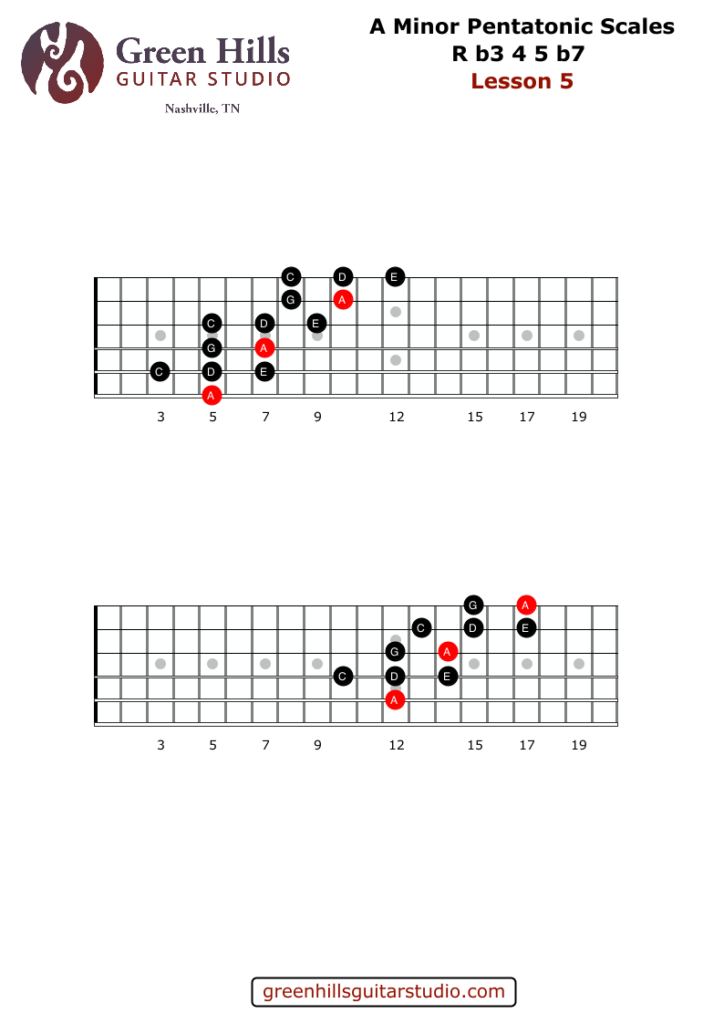
A simple A minor pentatonic improvisation routine
If you can play songs but freeze when it is time to solo, do not start by learning ten more scales. Start with a smaller routine that trains musical choices.
Here is a practical 20-minute routine using the A minor pentatonic diagrams above.
1. Root note check, 3 minutes
Choose one diagram. Play every A note you can find. Say “A” out loud as you play it.
Then improvise short phrases that always end on A.
This trains your sense of home base.
2. Three-note phrases, 4 minutes
Use only A, C, and E.
Make short phrases. Repeat them. Change the rhythm. Leave space.
This keeps your solo from becoming a scale run.
3. Add motion notes, 4 minutes
Now add D and G.
Notice how they want to move. Do not treat them as random extra notes. Use them to create movement toward A, C, or E.
4. One phrase, two positions, 4 minutes
Create a short phrase in one position. Move it to a nearby area of the neck.
Do not worry about making it perfect. The goal is to connect musical ideas across the fretboard.
5. Record and listen, 5 minutes
Record one minute of improvising.
Listen back and ask:
- Did I leave space?
- Did I repeat anything?
- Did I land on purpose?
- Did I use more than one position musically?
- Could I sing any of the phrases?
This kind of practice may feel less impressive than running fast patterns, but it builds the skill you actually need when it is time to improvise.
When should you move beyond the pentatonic scale?
The pentatonic scale is not something you graduate from and never use again. Great players keep returning to it because it works.
But you should expand beyond it when you begin hearing sounds that the pentatonic scale does not provide.
For example:
- If you want a sweeter major sound, you may need major scale notes.
- If you want stronger chord-tone targeting, you may need arpeggios.
- If you want modal color, you need to understand the chord and tonal center.
- If you want jazzier lines, you may need 7ths, 9ths, chromatic approach notes, and voice-leading.
- If you want better blues phrasing, you may need bends, microtones, call-and-response, and dominant chord awareness.
Still, none of those tools will solve the problem if you use them the same way you used the pentatonic box.
More information does not automatically create better improvisation. Better listening, phrasing, rhythm, and note choice do.
So yes, learn more scales. Learn modes. Learn arpeggios. Learn chord tones. But do not leave the musical work behind.
The real goal is not to know more diagrams. The goal is to make better choices with the notes you know.
The real reason you can play hard songs but still can’t improvise
If you can play difficult songs but cannot improvise, the issue probably is not that you lack ability.
It is more likely that your practice has emphasized execution more than choice.
You have trained your hands to reproduce music. Now you need to train your ear and mind to create it.
The A minor pentatonic scale is a great place to start because it is simple enough to manage but deep enough to keep teaching you for years. The same five notes can sound boring, expressive, tense, relaxed, vocal, aggressive, bluesy, melodic, or mechanical depending on how you use them.
That is the lesson.
The shape is not the solo. The scale is not the music. The diagram is not the destination.
Improvisation begins when you can take a small group of notes and make them mean something.
Schedule a guitar lesson in Nashville
If you can play songs but freeze when it is time to improvise, Green Hills Guitar Studio can help you connect the missing pieces.
In one-on-one guitar lessons, we can help you move beyond memorized scale shapes and start building real solos with better phrasing, stronger note choices, chord-tone awareness, ear training, and a clearer map of the fretboard.
Whether you want to play blues, rock, country, folk, pop, worship, jazz, or your own songs, the goal is the same: learn to play what you like to hear, then learn how to make it your own.
Ready to work on improvisation with a professional guitar teacher in Nashville?
![How to Find the Best Guitar Instructor [Parents & Adult Learners] | Green Hills Guitar Studio](https://greenhillsguitarstudio.com/wp-content/uploads/2026/02/How-to-Find-the-Best-Guitar-Instructor-Parents-Adult-Learners-768x512.jpg)