
Got to Hurry
Rhythm Guitar Lesson
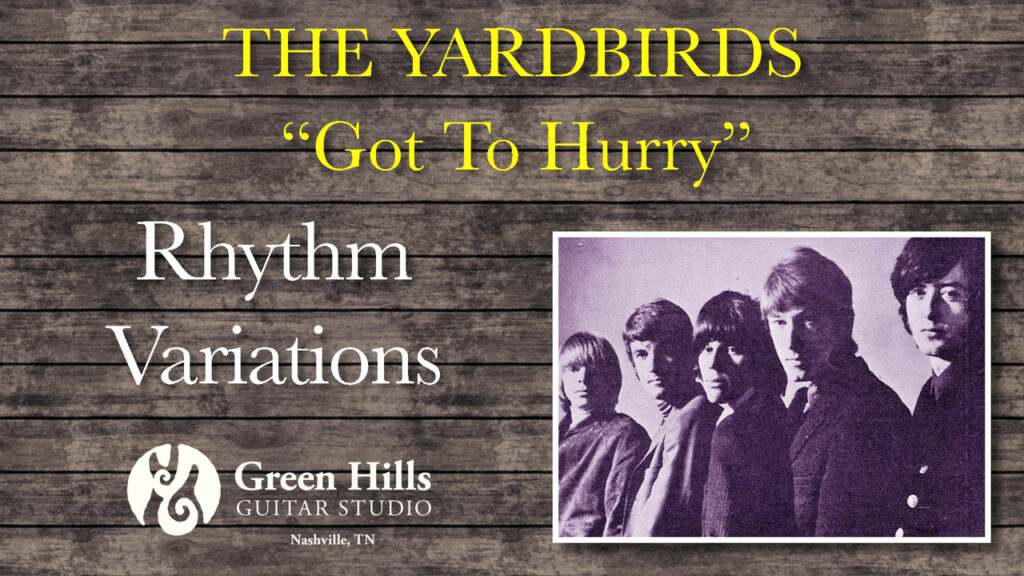
Learn blues rhythm guitar, chord inversions, shuffle variations, double stops, and practical rhythm parts through The Yardbirds’ “Got To Hurry.”
There is a lot more to rhythm guitar than strumming chords.
Great rhythm players know how to find the right voicing, stay out of the way, support the groove, leave space, and create movement without stepping on the vocal, the soloist, or another guitarist. That is one of the most important skills a guitarist can develop, especially in blues, rock, R&B, country, soul, and any setting with more than one instrument.
This course uses The Yardbirds’ “Got To Hurry” as a practical study in blues rhythm guitar. You’ll learn the primary rhythm part from the recording, then work through different variations, voicings, inversions, and approaches that show you how to build better guitar parts from a simple blues progression.
The goal is not to play more. The goal is to play better parts.
Learn How Rhythm Guitar Actually Works
A lot of guitarists spend years working on lead lines but very little time learning how to play strong rhythm guitar.
That creates problems in real musical situations. You might know the chords, but not know where to play them. You might be able to strum through a blues progression, but not know how to create a second guitar part. You might know a few barre chords, but feel stuck when you need a different register, a tighter groove, or a part that leaves more space.
“Got To Hurry” is a great place to work on those skills.
The song is built around a classic blues-rock shuffle feel, but the lesson goes far beyond memorizing one part. You’ll learn how to move dominant 7 chords around the neck, use inversions, create arpeggiated textures, add syncopated jabs, work with double stops, and blur the line between rhythm and lead playing.
That is the real value of the course: learning how to construct guitar parts that serve the music.
What You’ll Learn in This Course
This course teaches blues rhythm guitar through a complete rhythm study of The Yardbirds’ “Got To Hurry.” You’ll start with the core part, then learn how to vary it, arrange it, and apply the same vocabulary to other blues and shuffle progressions.
The Main “Got To Hurry” Rhythm Part
Learn the primary rhythm guitar part from the recording and understand how it supports the groove.
Dominant 7 Chords Across the Neck
Work with dominant 7 voicings from open position up the neck, including how to identify roots, 3rds, 5ths, and flat 7ths.
Chord Inversions
Use inversions to create new rhythm parts, change registers, and stay out of another guitarist’s way.
Shuffle and Boogie Vocabulary
Study the root, 5th, flat 7th, and octave movement that appears throughout blues, early rock, R&B, and British Invasion guitar playing.
Arpeggiated Rhythm Parts
Open up the arrangement with broken-chord textures instead of relying only on block chords or repeated strumming.
Jabs and Syncopation
Add rhythmic punctuation, accents, and movement without crowding the groove.
Space and Restraint
Learn how to leave room in a part, listen to the band, and make rhythm choices that support the song.
6th Licks and Double Stops
Break the chords into smaller two-note ideas that connect rhythm and lead guitar.
Transferable Blues Rhythm Concepts
Use the ideas from this course in other 12-bar blues, shuffle, rock, country, and R&B progressions.
What’s Included?
Inside the course, you’ll get 7 focused video lessons that walk you through the rhythm guitar ideas behind The Yardbirds’ “Got To Hurry.”
Lesson 1 teaches the primary blues rhythm part from the original recording. Lessons 2 through 7 expand that foundation with additional parts, voicings, inversions, rhythmic approaches, and arrangement ideas.
The course also includes 7 PDFs: one complete tabbed-out rhythm part for “Got To Hurry,” plus 6 chord and inversion reference PDFs. You’ll also get 2 custom backing tracks: one at the original tempo and one slowed down for focused practice.
The material is built around “Got To Hurry,” but the vocabulary applies to any 12-bar blues, shuffle, or blues-rock progression where you need to create a better rhythm part.


Learn from Shane Lamb
This course is taught by Shane Lamb, founder of Green Hills Guitar Studio in Nashville.
Shane’s teaching focuses on practical musicianship: how to understand the fretboard, build better parts, listen to the song, and make choices that work in real playing situations.
In this course, he uses “Got To Hurry” as a rhythm guitar workshop. You’ll learn the song, but you’ll also learn how working guitarists think about voicings, register, groove, restraint, and interaction with the rest of the band.
Who This Course Is For
This course is a good fit if you:
- Want to learn the rhythm guitar part to The Yardbirds’ “Got To Hurry”
- Want to get better at blues rhythm guitar
- Feel limited by open chords and basic barre chords
- Want to understand dominant 7 chords across the neck
- Need more rhythm options for 12-bar blues and shuffle progressions
- Want to play better in two-guitar settings
- Are working on chord inversions, double stops, and rhythm fills
- Want to connect rhythm guitar and lead guitar
- Want to create parts that support the band instead of crowding the song
- Like structured video lessons with tabs, PDFs, and backing tracks

How the Course Works
Learn the Core Rhythm Part
Start with the main “Got To Hurry” rhythm part and get the groove under your fingers.
Study the Chord Vocabulary
Work through dominant 7 chords, root locations, chord tones, and useful voicings across the neck.
Build Variations
Learn how to create different rhythm parts from the same progression using inversions, arpeggios, jabs, syncopation, and double stops.
Practice With Backing Tracks
Use the included backing tracks to work on time, feel, space, and musical application.
Listen Like a Rhythm Guitarist
Practice making choices based on what the song needs, not just what you know how to play.
Apply the Ideas Elsewhere
Take the chord voicings, rhythmic approaches, and double-stop vocabulary into other blues, rock, R&B, and country progressions.
Frequently Asked Questions
Build Better Blues Rhythm Parts
Rhythm guitar is not just the background. It is one of the main ways a song gets its feel, movement, and shape.
This course gives you a practical way to study blues rhythm guitar through a real recording, then turn that material into reusable vocabulary. You’ll learn the main part, study the chord shapes, build variations, practice with backing tracks, and develop a better sense of how to support the music.
If you want to stop defaulting to the same rhythm parts and start making smarter choices on the neck, this course is a strong place to start.